

Essential Eight cybersecurity Australia is no longer just a recommendation for government agencies. It has become a practical baseline for organisations of all sizes looking to strengthen their cyber resilience. With cyber threats continuing to evolve in scale and sophistication, understanding the ACSC Essential Eight explained framework is critical for businesses aiming to meet cyber security compliance Australia requirements in 2026.
This guide breaks down the Essential Eight maturity model, explains each mitigation strategy, and outlines why Essential Eight matters for Australian organisations today.
Introduction to Essential Eight Cybersecurity Australia
Essential Eight cybersecurity Australia refers to a set of baseline mitigation strategies developed by the Australian Cyber Security Centre. These strategies are designed to help organisations protect themselves against a wide range of cyber threats.
Originally intended for government systems, the framework has become widely adopted across industries. Businesses now view it as a practical starting point for improving their security posture and meeting cyber security compliance Australia expectations.
In 2026, ignoring this framework can leave organisations exposed not only to cyber incidents but also to regulatory and reputational risks.
What Is the ACSC Essential Eight Explained?
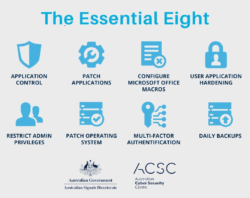
The ACSC Essential Eight explained framework consists of eight prioritised mitigation strategies that address common attack vectors. These strategies focus on preventing malware delivery, limiting attacker movement, and ensuring data recovery.
The framework is not a one-size-fits-all solution. Instead, it allows organisations to implement controls based on their risk profile through a structured maturity model.
The Essential Eight focuses on three key areas:
- Preventing initial compromise
- Limiting lateral movement
- Recovering data and maintaining availability
By implementing these strategies effectively, businesses can significantly reduce the likelihood of cyber incidents.
The Essential Eight Maturity Model
The Essential Eight maturity model provides a structured way to assess how well an organisation has implemented each mitigation strategy.
Maturity Levels Overview
| Maturity Level | Description | Risk Reduction |
| Level 0 | No formal controls in place | Minimal |
| Level 1 | Basic implementation | Low |
| Level 2 | Stronger controls with better consistency | Moderate |
| Level 3 | Advanced, fully aligned with threat landscape | High |
Each level represents increasing sophistication and resilience. Most organisations aim for at least Maturity Level 2, while those handling sensitive data often target Level 3.
The maturity model allows businesses to:
- Identify gaps in their current security posture
- Prioritise improvements
- Align with industry expectations
The Eight Mitigation Strategies in Detail
Application Control
Application control ensures that only approved software can run on systems. This reduces the risk of malicious applications executing.
Benefits include:
- Blocking unauthorised programs
- Reducing malware infections
- Improving system integrity
Patch Applications
Outdated applications are a common entry point for attackers. Regular patching ensures known vulnerabilities are addressed.
Best practices:
- Apply updates promptly
- Maintain an inventory of software
- Monitor for security advisories
Configure Microsoft Office Macros
Macros can be exploited to deliver malicious payloads. Restricting or disabling macros from untrusted sources reduces risk.
Key controls:
- Block macros from the internet
- Allow only trusted macros
- Educate users on risks
User Application Hardening
This involves configuring applications to reduce their attack surface.
Examples include:
- Disabling unnecessary features
- Blocking ads and scripts in browsers
- Limiting risky functionality
Restrict Administrative Privileges
Administrative accounts provide high-level access. Limiting their use reduces the impact of compromised credentials.
Strategies include:
- Using separate admin accounts
- Applying least privilege principles
- Monitoring privileged activity
Patch Operating Systems
Like applications, operating systems must be regularly updated to fix vulnerabilities.
Important steps:
- Automate updates where possible
- Test patches before deployment
- Ensure all devices are included
Multi-Factor Authentication
Multi-factor authentication adds an extra layer of security beyond passwords.
Benefits:
- Prevents unauthorised access
- Protects remote and cloud services
- Reduces credential-based attacks
Regular Backups
Backups ensure data can be recovered after incidents such as ransomware attacks.
Best practices:
- Maintain offline backups
- Test restoration processes
- Schedule regular backups
Essential Eight Checklist for Businesses
An Essential Eight checklist helps organisations track their implementation progress.
Basic Checklist
| Control Area | Key Action | Status |
| Application Control | Allow only approved apps | ☐ |
| Patch Applications | Update regularly | ☐ |
| Office Macros | Restrict usage | ☐ |
| App Hardening | Disable unnecessary features | ☐ |
| Admin Privileges | Limit access | ☐ |
| OS Patching | Keep systems updated | ☐ |
| MFA | Enable across systems | ☐ |
| Backups | Maintain secure backups | ☐ |
This checklist can be used as a starting point for internal audits and planning.
Why Essential Eight Matters in 2026?
Understanding why Essential Eight matters is crucial for modern businesses.
Increasing Cyber Threats
Cyber attacks are becoming more targeted and complex. Organisations that lack baseline protections are more vulnerable.
Regulatory Expectations
Cyber security compliance Australia requirements are evolving. Many industries now expect alignment with recognised frameworks like the Essential Eight.
Business Continuity
Cyber incidents can disrupt operations, leading to financial losses and reputational damage. Implementing the Essential Eight helps maintain continuity.
Supply Chain Security
Businesses are increasingly required to demonstrate security maturity to partners and clients.
Challenges in Implementing the Essential Eight
While the framework is practical, implementation can be challenging.
Resource Constraints
Small and medium businesses may lack dedicated security teams.
Technical Complexity
Some controls require advanced configuration and monitoring.
Cultural Barriers
User behaviour and organisational culture can impact adoption.
Ongoing Maintenance
Cyber security is not a one-time effort. Continuous monitoring and improvement are required.
How to Get Started with Cyber Security Compliance Australia?
To begin implementing the Essential Eight, organisations should take a structured approach.
Step 1: Assess Current State
Conduct a gap analysis against the Essential Eight maturity model.
Step 2: Prioritise Controls
Focus on high-impact areas such as MFA and patching.
Step 3: Develop a Roadmap
Create a phased implementation plan aligned with business goals.
Step 4: Train Staff
Educate employees on security practices and responsibilities.
Step 5: Monitor and Improve
Regularly review controls and update them as threats evolve.
Conclusion
Essential Eight cybersecurity Australia has become a foundational element of cyber security compliance Australia in 2026. By understanding the ACSC Essential Eight explained framework and adopting the Essential Eight maturity model, organisations can significantly reduce their exposure to cyber threats.
Implementing the Essential Eight checklist is not just about compliance. It is about building resilience, protecting data, and ensuring business continuity in an increasingly complex threat landscape.
For organisations looking to strengthen their cyber security posture, taking a structured and informed approach is essential. If you need guidance on aligning your systems with the Essential Eight, ITSwitch provides practical support and expertise.
Contact us to learn more.
Frequently Asked Questions
Is the Essential Eight mandatory?
It is not universally mandatory, but many government agencies and industries expect compliance or alignment.
What is the Essential Eight maturity model?
It is a scale from Level 0 to Level 3 that measures how effectively an organisation has implemented the framework.
Why Essential Eight matters for small businesses?
Small businesses are often targeted due to weaker security. The framework provides a practical baseline to reduce risk.
How long does implementation take?
It depends on the organisation’s size and existing controls. It can range from a few months to over a year.
Latest Blog

What Is the Essential Eight & Why Australian Businesses Can’t Ignore It in 2026

How Managed IT Services Melbourne Boost SMB Productivity

How Microsoft Teams Voice Integration Improves SMB Communication in Melbourne

Secure IT Asset Relocation: Best Practices for Businesses